
Resin or plastic for an art object: durability, detail and the Dubai sun
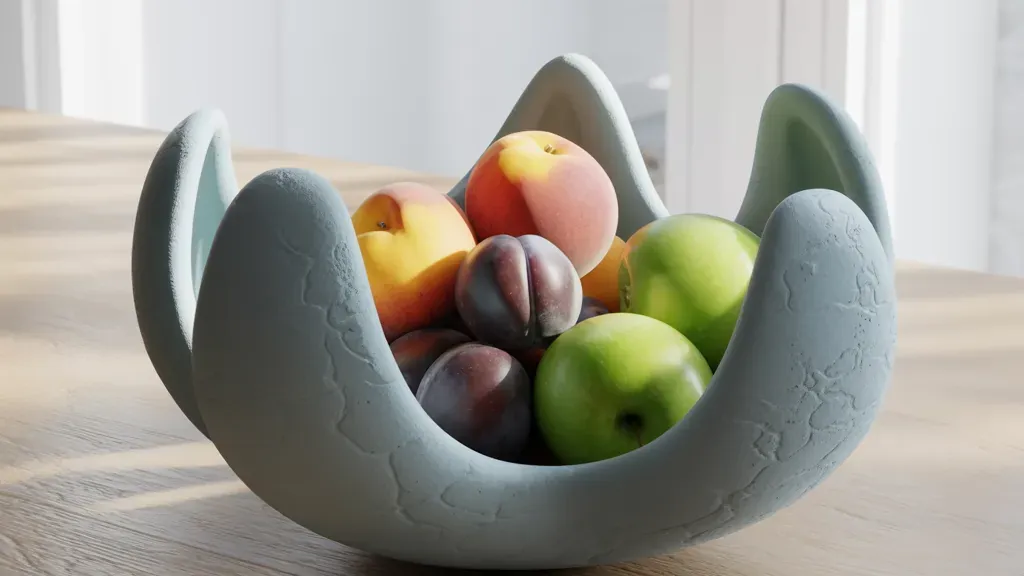
Resin holds the detail. Plastic survives the summer. That is the short version of the material decision for an art object, and in Dubai the second half of that sentence usually wins the argument.
The question reaches us in almost the same words every month: should the piece be resin or plastic? The useful answer has little to do with which material is better and everything to do with where the finished object will stand. A 40 cm figure on a lit plinth inside a gallery and a 2 m form on a hotel terrace in July are two different problems wearing the same sketch.
If you are still choosing a printing process rather than a material, FDM, SLA or SLS covers that ground. Here we stay on the finished object and what it has to live through.
Resin or plastic for an art object: the real difference
SLA resin is a liquid photopolymer cured layer by layer with light. Layers can be very thin, so edges come out crisp, lettering stays readable at small sizes, and surface texture survives. Cured resin is hard and it is brittle in a specific way: it chips. Drop a resin piece on tile and you lose a fingertip or the edge of a wing.
FDM plastic is a thermoplastic filament laid down in beads. You get strength in the plane of each layer and a weaker bond between layers, so an FDM piece tends to split along a layer line rather than shatter. Layer lines are visible until somebody sands them away, which on a display piece means several rounds of filler and primer.
So resin wins on what the eye sees up close. Plastic wins on scale, on impact, and above all on heat.
Where the piece will stand decides more than the spec sheet
Before we talk materials with an artist, we ask where the piece will live, indoors, outdoors, or outdoors under cover, how many months it needs to look new, whether people will touch it or lean on it, and whether it can come back to us once a year for refinishing.
Indoors, the material question is almost free. Air conditioning holds the temperature, window light carries little UV through glazing, and nothing sandblasts the surface. Resin, PLA, PETG, almost anything behaves itself. The decision collapses into detail, weight and budget.
Outdoors in this city, the environment does the choosing. Direct sun, surface heat far above air temperature, blown sand, irrigation spray on a landscaped plinth, pressure washing by a cleaning crew who were not told the piece is printed.
SLA resin: detail nobody else gives you, and where it stops
For ornament, lace-like structures, faces at small scale and anything where a 1 mm feature has to read as a 1 mm feature, resin is the only sensible answer. We print collectible and display work this way and the finish needs far less sanding than FDM, which matters when the sculpture has texture you do not want to lose under filler.
Outdoors, resin runs into its limits. Post-curing has to be done properly, because an under-cured part stays slightly soft and keeps reacting. Ultraviolet light is the bigger issue: it never stops working on a cured part. Raise3D's write-up on resin print lifespan describes the mechanism plainly: UV breaks polymer chains, which shows up as yellowing, then stiffening, then micro-cracking.
We will not give you a figure in years for how long a resin piece survives outside. Published numbers disagree with each other by a wide margin, and none of them were measured in the Gulf. What we see on our own standard-resin parts after months of sun is consistent though: yellowing appears first on the lit face, and the first physical failure is chipping at thin, unsupported edges. A clear UV-inhibiting coat slows that down. It does not cancel it.
FDM plastics for an outdoor piece: PLA, PETG, ABS, ASA
Published heat figures for the common filaments are close enough to agree on. An HDT chart compiled from filament datasheets puts standard PLA at about 53 °C heat deflection with a glass transition near 60 °C, PETG at 68 to 74 °C, ABS at 85 to 98 °C, and ASA around 88 °C. Treat them as the point where the material starts to care about temperature, not the point where it melts.
- PLA. Prints beautifully, takes fine detail better than people expect, cheap at volume. For anything that sees full sun here it is out of the question. It also goes brittle under UV over a season.
- PETG. Tougher, holds up to humidity and washdown, more forgiving of a knock. Detail is softer than PLA because it tends to string and round over small features. Fine for sheltered outdoor work and for the structural guts of a piece.
- ABS. Sands and solvent-bonds better than anything else on this list, which is why it is pleasant to finish and to assemble. Sunlight is its weakness: colour goes and the surface gets brittle.
- ASA. Mechanically close to ABS and formulated for weathering, which BigRep's comparison of ASA and ABS sets out in detail. It is our default when a piece is going to live outside. It is also the hardest of the four to print at size, because it warps and wants a sealed, heated chamber, so expect the print time and the reject risk to reflect that.
Dubai heat and sun: where ordinary materials give up
Air temperature is the wrong number to design against. A dark object standing in full sun runs far hotter than the air around it, and there is local measurement to hang that on. A 2023 study of pavement in the UAE, published in Case Studies in Construction Materials, recorded a standard pavement surface at 60 °C in summer, falling to 47 °C once surface reflectance was raised from 24% to 70%.
That is pavement, not sculpture. But a matte black form on a sun-exposed plinth absorbs light the same way a dark road does, and 60 °C sits above PLA's heat deflection point and right at its glass transition. What that looks like in practice is not dramatic. Nothing puddles. An overhang sags a few millimetres, a wide base bows so the piece reads as leaning, a glued joint creeps, and three months later the silhouette is subtly wrong and nobody can say when it changed.
The other load is cycling. Hot afternoon, much cooler night, repeated for a season. Rigid filler in a seam and flexible plastic either side of it do not move together, and the seam telegraphs through the paint first.
Paint, pigment and finish are part of the material decision
Choosing a colour for an outdoor piece is a thermal decision as much as an aesthetic one. The pavement study above is the cleanest illustration we have of the difference reflectance makes, and it applies to a sculpture: a pale or metallic finish will run cooler than a deep matte black in the same spot, which buys the plastic underneath real margin.
Pigment also shields. An opaque pigmented topcoat keeps UV off the polymer, and that protects resin far more effectively than a clear coat does. We use automotive-grade primer and 2K clear on display work precisely because it is a system built for sun, and because it can be flatted back and recoated later instead of stripped.
How many rounds of sanding, filling and priming a piece takes is covered in 3D print finishing. For an outdoor commission, add one more design requirement: it has to be refinishable. A piece that can be scuffed and resprayed on site in a morning will look good for years. A piece with deep crevices nobody can reach will not.
Hybrid pieces: resin detail on a plastic body
Most of the interesting work ends up mixed, and this is the part the general guides skip. We print the mass, the base and the mounting points in FDM, usually ASA for outdoors, then print the elements that carry the detail in resin: a face, ornament, lettering, a filigree section. Then everything disappears under the same primer and paint, and the viewer sees one object.
Different materials expand by different amounts, so keep resin elements compact and let the joint, not the resin, absorb movement. A long thin resin strip bonded along a plastic panel will crack somewhere in its first summer. Bond mechanically wherever you can too, with a pin, a socket or a captive screw, so the adhesive is holding alignment rather than carrying load.
Size, seams and lifespan: how we choose for a specific piece
Anything bigger than the build volume gets printed in sections and assembled, which is its own craft with its own seam-and-fastener logic. For an outdoor piece the seam gets more attention than the surface: stepped mating faces instead of butt joints, internal ribs, fasteners rather than glue alone, and a filler with some flexibility in it. A rigid seam on a 3 m outdoor form is where it will eventually show.
In plain terms, this is how it usually lands. Indoors with fine detail: resin. Indoors and large: FDM with serious finishing hours. Outdoors for an event or one exhibition season: FDM in PETG or ABS, pigmented, no agonising. Outdoors for years: ASA, light finish, shade where the brief allows, and an agreed maintenance visit. Fine detail that has to live outdoors: hybrid, with the resin kept small and coated opaque.
Cost follows the same variables rather than the material name: part volume, layer height, how much support material the geometry demands, how many hours of hand finishing the surface needs, how many sections and how they join, and how fast you need it. We quote each piece after seeing the file, a sketch or even a clear description. Send what you have through the contact form or WhatsApp and tell us where the piece will stand, because that one line changes the answer more than anything else in the brief.
FAQ
Can you use a 3D printed resin piece outdoors in Dubai?
You can, with conditions. Print in a UV-stable resin where the geometry allows, post-cure it properly, and finish it with opaque pigmented paint rather than clear coat so sunlight reaches the coating instead of the polymer. Accept that it is a maintained object and not a set-and-forget one. For a piece that has to stand unattended in full sun for years, we would rather print the body in ASA and keep resin for the detailed elements.
What is the best 3D printing material for an outdoor sculpture here?
ASA, for most outdoor commissions. It has roughly the mechanical behaviour of ABS with a formulation built for weathering, and its heat deflection temperature near 88 °C leaves margin above the surface temperatures a dark object reaches in summer. It is harder to print at size, so the trade is print risk and time against years of life.
Does resin yellow in the sun, and can you prevent it?
It yellows, and no, not permanently. UV breaks bonds in the cured polymer, which produces the colour shift and later the brittleness. UV-inhibiting clear coats slow it. An opaque pigmented finish hides and shields it much better, which is why we rarely leave an outdoor resin element in a natural or translucent finish.
Is PLA strong enough for an outdoor art object?
Strength is not what fails. PLA is stiff and prints well, but its heat deflection sits around 53 °C with a glass transition near 60 °C, and a dark surface in direct sun here reaches that range. The failure is slow deformation rather than a crack: a bowed base, a drooping overhang, a piece that starts to lean. Indoors PLA is perfectly reasonable.
Can one piece combine resin detail with FDM durability?
Yes, and it is how we build most detailed outdoor work. FDM carries the mass and the mounting, resin carries the ornament, and a unified paint system makes the join invisible. Keep the resin parts compact, bond them with a pin or screw as well as adhesive, and design the joint to tolerate a little thermal movement. We can show examples of mixed-material pieces on request.