Large scale 3D printing: how pieces bigger than the printer are made

A printer has a bed, and the bed has edges. A two metre sculpture or a wall panel for a hotel lobby does not fit on it. It still gets printed. The model is cut into sections on the computer, printed piece by piece and joined into one object. At SL3D everything larger than the bed is made this way, which is why our sizes run from 5 cm up to 15 metres.
Where the cuts go
Splitting the model is the part of the job nobody sees, and it decides how the finished piece looks. A seam that runs along an edge, a fold or a change of texture disappears after finishing. A seam across a smooth flat face is the hardest to hide, so that is the last place to put one.
The cut lines also follow practical limits:
- each section has to fit the bed with some margin;
- each section should print in a stable position, with as few supports as possible;
- the sections have to go together in an order that a person with two hands can manage;
- the finished piece, or its largest assembled part, has to pass through the door, the lift and the corridor on the way to where it will stand.
The last point sounds obvious. It is also the one that gets forgotten most often, because on a screen everything fits through every door.
How sections find each other
Two flat faces glued together will drift while the adhesive sets. So the sections get keys: pins and sockets, tongue and groove, dovetails. They are modelled into the parts and printed with them. The keys do the aligning, the adhesive does the holding.
For a small object that is enough. A sculpture that people will lean on, or an installation that hangs over visitors' heads, needs more than glue. It gets an internal frame or hidden fasteners, and the way the load travels through the piece is worked out before printing starts.
Thin walls, light pieces
A big print is almost never solid. Solid plastic is heavy, slow to print and tends to warp as it cools. Large parts are printed as shells with a lattice inside, and the wall thickness is chosen for the job: a piece that stands in a corner can be lighter than a bench people sit on.
Weight matters twice. It decides how the piece is fixed to the floor, wall or ceiling, and it decides how many people it takes to carry it in.
The seam after assembly
Once the sections are joined, the seams are filled and sanded, then the whole surface is primed and painted. After primer a well placed seam is hard to find even when you know where to look.
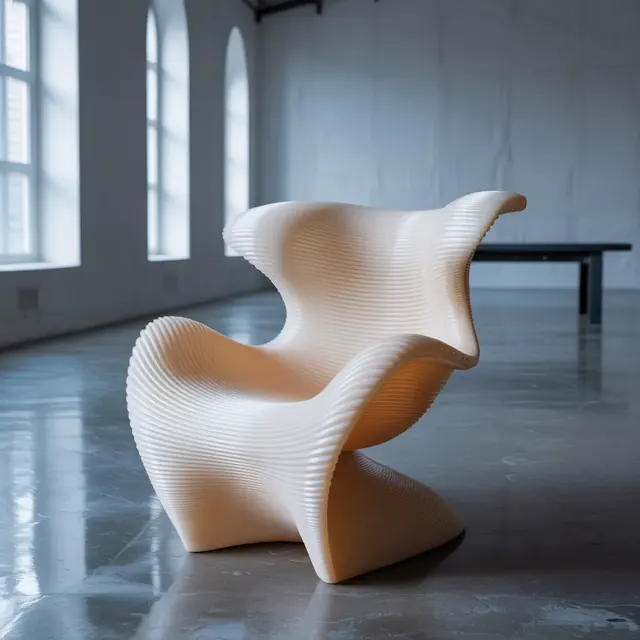
Finishing is also where the layer lines go, if the design calls for a smooth surface. Some designers keep them on purpose. On a large form they work a bit like the grain in wood.
Indoors or outdoors
In Dubai this question matters more than in most places. Ordinary PLA starts to soften at around 60°C, and a dark object in direct summer sun gets hotter than the air around it. For a piece that lives indoors this is irrelevant. For a terrace, a shop front or a car park it decides the material.
Tell us where the piece will stand before we start. Changing the material later means printing again.
What we need from you
You do not need a finished print file to start. For a large piece we ask for:
- the model, a sketch or reference images;
- the overall dimensions;
- where it will stand and how it will be fixed: on the floor, on a wall, hanging;
- whether people will touch it, sit on it or only look at it;
- the access route on site: door width, lift size, stairs;
- the date it has to be installed.
From that we work out the technology, the sections and the finish, and send a quote. If you are choosing between technologies, our comparison of FDM, SLA and SLS explains why large pieces almost always start with FDM.
The method is the same at every scale. A 40 cm figure printed in two halves and a 15 metre structure printed in many sections follow the same logic, the second one just takes far more planning.